|
|
 |
 |
 |
 |
 |
 |
 |
 |
 |
 |
 |
 |
 |
 |
|
Ghusl
There are two types of ghusl, the obligatory (compulsory) ones (farz) and the recommended ones (sunnat). There are seven obligatory ritual baths. The ritual bath should be preceded by Istinjaa and wuzu as described earlier. While doing wuzu you should take the name of the ghusl for which you are purifying yourself. Certain important guidelines are been set by our Imaams for the obligatory ghusl which should be followed strictly. First the impurity should be removed from the private parts with water and thereafter water should be poured freely over the whole body. The hands should be used to cleanse that part of body, which they can reach. No part of the body should remain dry and being not washed by water and massaged by the hand. Water should reach the skin underneath the hairs. You should turn your bracelet or a ring or any other ornament so that water reaches the skin beneath it. Maulana Ali (AS) said, 'If one has dealt with the whole of the body, rubbed it with the hands, washed away every kind of uncleanness and poured water on the hairs so that it has reached the skin underneath it, and has performed Istinjaa and wuzu prior to ghusl, then, indeed, he has been purified himself.' The niyyat of obligatory ghusl is given below. One has to insert the name of the particular ritual bath, which is due, in the niyyat below.
"O Allah! I am taking this ritual bath to purify myself because of -- (name of ghusl) -- which is obligatory on me. In the name of Allah Who is the Greatest." The names of the obligatory ghusl are enumerated below with their individual instructions. 1: The ghusl of an unbeliever embracing Islam:
If an unbeliever embraces Islam, he has to perform ghusl which is obligatory. The name of the ghusl, "le quboole deenilahe" should be inserted in the Niyyat mentioned above. 2: The ghusl of 'ehtelaam' (wet dream):
3: The ghusl of 'janaabat' (sexual intercourse):
4: The ghusl of 'haiz' (menstruation):
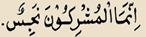
The menstrual period usually lasts for minimum 3 days to maximum 10 days. The blood of menstruation is to be distinguished from that of constant haemorrhage (istehaaza). The blood of menses is dirty, thick and fetid while the blood of haemorrhage is thin and watery. When the blood of menses begins to flow, the woman should observe the rules governing menstruating women, and when it stops she should take the ritual bath. Woman should take ritual bath after she finds that the blood has stopped. When a woman discovers that she is free from menstruation, and she misses or delays taking a ghusl, it becomes incumbent upon her to offer that prayer, as well as any other prayer which she has missed during the time of her purity. The evidence of the stoppage of menstruation is that the cotton pad or any other thing inserted in the private parts is found to be free from impurity. When this is confirmed, the woman is free to perform the ritual bath and offer her prayers. A menstruating woman should not read the Qur'an, or enter a mosque, or pray, or perform fasts, or go for ziyaarat, or have sexual intercourse until she is purified. When she becomes pure from menstrual impurity, she may perform the fasts, which she was not able to perform, but not the prayers which she missed during her periods. Imaam Mohammad Baaqir (AS) said, 'A menstruating woman should perform the ablution fully for every prayer and should face the qibla but without imposing prayers on her, she should recite the tasbeeh of 'Subhaan allah', 'Alhamdo lillah', and 'laa ilaha illallaah' at the time of prayers.' Physical contact with a menstruating woman is permitted, the way that she should wear an undergarment below the navel to the knee, and the husband is entitled to make love above the garment. He who has sexual intercourse with a menstruating woman has, indeed, done an act which is not lawful to him. It is incumbent on him in such a case to ask for Allah's pardon and to repent of his act. A child, as a result of conception at the time of menses, would contract the disease of Leprosy. If a woman conceives a child in her womb at the time of her periods, then, the child would be the enemy of the Progeny of Mohammad Rasulullah (SAWS), says in his Hadees-e-shareef,
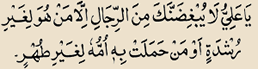
"O Ali, only he would be the person with your hatred and enmity in his heart among the people, to whom, Allah has not given guidance or who might be the result of conception in her mother’s womb at the time of her impurity." A woman who discovers blood during her period of purity, and if the blood is like
that of menses, then she should observe the rules accordingly. On the contrary,
if the blood is thin and watery not matching to the characteristics of menstrual
blood, she should insert a piece of cloth or a cotton pad in her private part
as a precaution against bleeding and she should perform ablution before every
prayer and her husband has access to her. A woman who experiences continuous bleeding
(istehaaza) due to some disease and the character of the blood does not match
with that of menses, then she should bathe before every two prayers i.e. namaaz
of zohr and 'asr, namaaz of maghrib and 'isha il-aakherat, and namaaz of fajr.
A woman who suffers from continuous bleeding is deemed to be menstruating. The
rule is the same when blood is discovered by a woman who is pregnant. Imaam Ja'far
us-Saadiq (AS) said, 'Allah will cure every woman who suffers from istehaaza if
she faithfully observes these rules.'
5: The ghusl of 'nifaas' (after childbirth):
6: The ghusl of 'mayyet' (dead body):
7: The ghusl of 'majnoon' (lunatic):
The ritual bath is obligatory after the lunatic or one who loses his consciousness recovers his senses. The name of the ghusl, "le tehseelil 'aqlis saleeme" is added in the Niyyat given above. The ghusl is obligatory after one has fallen into filth or dirt and has spoiled the whole body. The name of the ghusl, "le tahaaratil jisme" is added in the Niyyat given above. The above mentioned seven ghusl are obligatory. Apart from the obligatory ghusl, there are other ghusl of sunnat which Rasulullah (SAWS) recommended. To perform these ghusl is praiseworthy. These ghusl are: of Friday before prayers, of the two festivals namely 'eid-ul-azhaa and 'eid-ul-fitr, of ehraam at the commencement of Hajj, for entering the Mecca, for entering the Ka'ba, for entering the Medina, on the Day of 'Arafa, on the 1st and 27th night (Lailatul Me'raaj, Shab-e-Me'raaj) of Rajab-ul-Morajjab, on 15th night (Lailatun Nisf, Shab-e-Baraat) of Sha'baan, on the three nights of Ramzaan-ul-Mo'azzam namely the 17th, 19th, 21st night and the 23rd night (Lailatul Qadr) of Ramzaan. The bath of these nights should be taken before the commencement of its prescribed prayer (washsheek) and these nights be passed in wakefulness and prayer. Likewise the bath is to be taken after giving bath to a dead person. | |
|
| |
|
|
|
|
Copyright © 2004 Alavibohra.org. All rights reserved. Vadodara. | |